The Agent Loop: How AI Agents Actually Work (and How to Build One)

.jpg)
AI is shifting from systems that answer questions to systems that get work done. This is known as agentic AI—AI that can understand a goal, plan steps, take actions, evaluate outcomes, and continue until the task is complete.
For developers, this isn’t a model upgrade. It’s a new way to design software.
This article breaks down the Agent Loop—the core concept behind AI agents—and shows how modern tooling such as LLMs, Agentic APIs (including You.com), memory systems, and evaluation layers fit into each step.
What Is an AI Agent?
An AI agent is a system designed to understand a goal, gather relevant context, and plan a sequence of steps to achieve that objective.
Unlike traditional chatbots that just respond to prompts, AI agents take initiative by actively taking actions using tools or APIs, continuously evaluating results, and deciding whether to continue or stop based on their progress.
In essence, while chatbots are focused on providing answers, AI agents are built to act autonomously and persistently, moving forward until the task is completed.
Goal (LLM)
↓
Context (You.com Agentic API + memory)
↓
Plan (LLM + orchestration)
↓
Action (Agentic APIs)
↓
Evaluate (validators + observability)
↺ or Stop
The Agent Loop
Every AI agent operates around a loop. This loop is what gives agents autonomy, reliability, and the ability to recover from failure.
Let’s walk through each step—and the tooling commonly used at each stage.
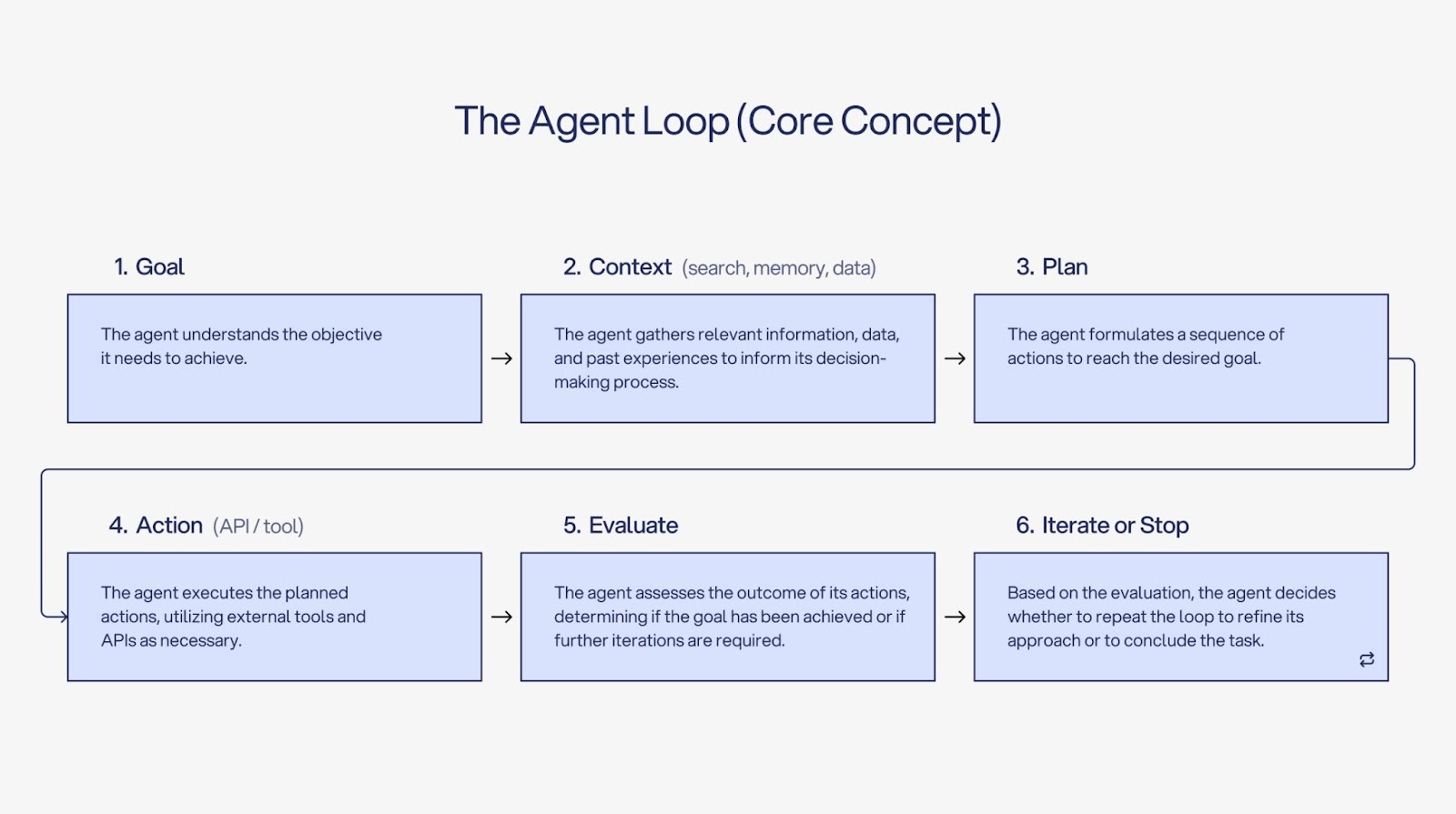
1. Goal
The process for an AI agent begins with a clearly defined goal, such as summarizing recent customer feedback, resolving a support ticket, or preparing a competitive brief.
These goals are typically interpreted by a large language model (LLM), but it’s essential that they are structured and constrained by the system rather than left as open-ended prompts.
The system uses a combination of tools, including LLM providers like OpenAI (GPT-4, GPT-4 Turbo), Anthropic (Claude 3.5 Sonnet, Claude Opus), Google (Gemini Pro, Gemini Ultra), Meta (Llama 3, Llama 3.1), Mistral (Mistral Large, Mixtral), and Cohere (Command R+), as well as open-source models such as Llama and Mixtral accessed via platforms like Hugging Face, Replicate, or Together AI.
In addition to these tools, the system enforces rules through task definitions, input validation, and goal templates to ensure clarity and reliability.
A well-defined goal, supported by the right tooling and system constraints, forms the foundation of a dependable AI agent, enabling it to operate effectively and deliver consistent results
2. Context
Before an AI agent can begin planning or executing tasks, it first has to gather relevant context.
This context can come from a variety of sources, including real-world information, internal documents, records of past actions and outcomes, as well as both structured and unstructured data. Context is essential because it grounds the agent in reality; without it, agents are prone to hallucinations or generating inaccurate information.
To collect and utilize this context, agents rely on a suite of tools and systems.
- Agentic APIs, such as those provided by You.com, Brave, Serper, and SerpAPI, enable real-time search and retrieval of web-based information, ensuring that agents have access to the most current data.
- Vector databases like Pinecone, Weaviate, Qdrant, Chroma, and Milvus store high-dimensional embeddings of documents and interactions, allowing agents to perform semantic searches and retrieve contextually similar information.
- Retrieval systems, including LlamaIndex, LangChain retrievers, Elasticsearch, and OpenSearch, further enhance the agent’s ability to access and integrate relevant data into its workflow.
- Memory and state management are also crucial. Technologies such as Redis, PostgreSQL, and Mem0 provide session memory, persistent state, and specialized agent memory layers, enabling agents to recall past interactions and maintain continuity across sessions.
- Internal APIs connect agents to company databases, CRM systems, and document repositories, ensuring access to proprietary and organizational knowledge.
Unlike traditional retrieval-augmented generation (RAG), agentic search must support real-time reasoning and dynamic knowledge integration. This is why agentic APIs, like those from You.com, are becoming foundational infrastructure for modern AI agents, allowing them to interpret outcomes, evaluate options, and adapt their actions as new information becomes available .
3. Plan
Using the goal and gathered context, an AI agent generates a plan that outlines what needs to happen, which tools are required, and the order in which actions should be executed. This plan serves as a detailed guide for accomplishing the task, but it is inherently dynamic—agents must be capable of re-planning if any action fails or circumstances change.
To support this process, agents leverage LLMs with reasoning capabilities, such as OpenAI’s function calling, Anthropic’s tool use, and Google’s Gemini function calling.
Additionally, planning and orchestration frameworks like LangGraph, CrewAI, AutoGPT, ReAct, and chain-of-thought prompting help agents devise and manage multi-step workflows that combine reasoning with action. Workflow control is further managed through custom orchestration logic, state machines, and tools like Temporal and Prefect, which enable sophisticated control over task execution, dependencies, and retries.
Together, these tools empower agents to create flexible, adaptive plans that drive effective task completion.
4. Action
The action phase is where agents transform their plans into real-world outcomes by interacting with various external systems. Typical actions might include executing payments, updating CRM records, sending notifications, scheduling meetings, or writing and modifying data across different platforms.
To perform these tasks, agents rely on a range of specialized tools and APIs.
- For payments and commerce, integrations with services like Stripe, PayPal, Square, and Shopify enable secure transactions.
- CRM and sales operations are managed through platforms such as Salesforce, HubSpot, Pipedrive, and Close.
- Communication tools like Twilio, SendGrid, Slack, Discord, and Intercom allow agents to send messages and notifications efficiently.
- Scheduling tasks are handled through Calendly, Google Calendar API, and Microsoft Graph.
- Project management actions can be executed via Linear, Jira, Asana, and Notion.
- For data and storage needs, agents utilize Airtable, Google Sheets API, AWS S3, and Supabase.
- Developer and internal operations are supported by integrations with GitHub, GitLab, Vercel, and internal microservices.
It is crucial that these actions are carried out using predictable, idempotent Agentic APIs to ensure safety and reliability, as this prevents unintended consequences when executing real-world operations.
5. Evaluate
After an AI agent takes action, it must evaluate the outcome to determine whether the action succeeded, if it moved the agent closer to the goal, and whether the overall task is complete. This evaluation phase is critical because it transforms agents from simple demos into reliable production systems.
To assess success, agents use a combination of rule-based validation methods—such as HTTP status checks, schema validation, and business rules—and large language model (LLM)-based evaluations, which include semantic outcome checks and custom success prompts.
Observability tools like LangSmith, Weights & Biases, Datadog, and custom logging solutions (e.g., using Postgres or S3) play a vital role by tracking every tool invocation, parameters, and results, enabling detailed analysis of the agent’s reasoning and actions.
This comprehensive evaluation process ensures that agents not only produce correct final answers but also follow efficient, logical execution paths, handle errors gracefully, and adapt their approach as needed. By continuously validating outcomes and monitoring behavior, agents can iterate until the task is complete or determine when completion is not possible, thereby improving reliability and trustworthiness in real-world applications.
6. Iterate or Stop
After evaluating the outcome of its actions, an AI agent must decide whether to iterate—by re-planning and continuing its work—or to stop, either because the task is complete or because it has encountered an unsafe or unresolvable situation.
This decision is governed by control logic, which may include conditional branching, state machines, or workflow engines such as LangGraph and Temporal.
To ensure safety and efficiency, agents are equipped with safeguards like rate limits, iteration caps, timeouts, and spend limits, which prevent runaway autonomy and uncontrolled resource consumption. If the agent encounters a scenario that requires human intervention or exceeds its safety boundaries, escalation mechanisms such as human-in-the-loop triggers, Slack or PagerDuty alerts, and fallback logic are activated.
This structured approach ensures that agents operate within defined boundaries, making autonomous decisions when appropriate but always with mechanisms in place to halt or escalate when necessary, thus preventing uncontrolled or unsafe behavior
Common Mistakes When Building Agents
When developing AI agents, several common mistakes can undermine their effectiveness and reliability.
Treating Agents Like Chatbots
While chatbots are designed primarily to answer questions or respond to prompts, agents are meant to act autonomously, pursuing goals through a series of steps and decisions. Failing to recognize this difference often results in agents that are passive and incapable of carrying out complex tasks.
Providing Weak or Missing Context
Agents require rich, relevant information about their environment, objectives, and past actions in order to make informed decisions. Without sufficient context, agents may “hallucinate”—making up information or taking misguided actions that do not align with reality or user intent.
Skipping or Neglecting the Evaluation Layer
Evaluation allows agents to assess whether their actions have succeeded, determine if they are moving toward the intended goal, and decide if further steps are necessary. Without an effective evaluation mechanism, agents may continue down unproductive paths, repeat mistakes, or fail to recognize when a task is complete.
Setting Overly Broad Goals
This mistake can overwhelm the agent and lead to confusion or inefficiency. Goals should be specific and well-defined, giving the agent clear direction and boundaries. Vague or open-ended goals make it difficult for agents to plan effectively and measure success.
Granting Too Much Autonomy Too Early
Early-stage agents should prioritize reliability and operate within well-defined safety limits, gradually increasing their autonomy as they demonstrate consistent, trustworthy performance. Striking the right balance between reliability and autonomy is crucial—reliability should always come first, ensuring that agents act safely and predictably before expanding their scope and independence.
Why Search Matters for Agents
When building AI agents, it’s important to recognize that LLMs primarily rely on their training data, while retrieval-augmented generation (RAG) systems enhance this with access to internal documents. However, agents must also be able to access real-time external context to function effectively. This real-time information is crucial for verifying assumptions, grounding decisions in up-to-date facts, and ensuring that agents act safely within the current environment. Without the ability to search for and retrieve fresh data, agents risk making outdated or inaccurate decisions.
This is where search-focused Agentic APIs, such as the You.com Agentic API, become essential. These APIs provide agents with access to real-time web data, structured outputs, and source attribution, all backed by production-grade reliability. By integrating such APIs, agents can continuously validate their knowledge against the latest information, trace their sources, and maintain transparency in their decision-making processes.
Think of search as the essential context layer that keeps agents honest and reliable. The goal of agentic AI isn’t just about building smarter models, it’s about establishing clear goals, grounding actions in accurate and current context, executing reliable actions, and engaging in continuous evaluation.
The Agent Loop—comprising goal setting, context gathering, planning, action, evaluation, and iteration—serves as the blueprint for building effective agents, while search-focused agentic APIs provide the infrastructure that makes this loop work in practice.
With these principles and tools in place, you’re ready to build agents that are both capable and trustworthy.
Now, go build.
Featured resources.
.webp)
Paying 10x More After Google’s num=100 Change? Migrate to You.com in Under 10 Minutes
September 18, 2025
Blog
September 2025 API Roundup: Introducing Express & Contents APIs
September 16, 2025
Blog

You.com vs. Microsoft Copilot: How They Compare for Enterprise Teams
September 10, 2025
Blog
All resources.
Browse our complete collection of tools, guides, and expert insights — helping your team turn AI into ROI.

ARI vs. ChatGPT Deep Research vs. Google Deep Research: Why Businesses Are Choosing ARI
March 17, 2025
Blog

Introducing ARI: The First Professional-Grade Research Agent for Business
February 27, 2025
Blog

You.com and Inversity Launch the First-Ever Personalized GenAI Training Program: Get Certified Today
February 19, 2025
Blog

Generative AI 101: Key Benefits for Companies Today and How to Get Started
February 13, 2025
Blog

Celebrating 50,000 Custom Agents Made on you.com
January 26, 2025
Blog
.png)
You.com founder Richard Socher's plan to win the AI search wars
December 6, 2024
News & Press

How Mimecast Uses You.com to Drive GTM Productivity
November 26, 2024
Case Studies
These AI-assisted innovations are from startups that are less than five years old
November 19, 2024
News & Press